



Kandla port awards India’s first commercial hyperloop freight project to IIT-Madras startup

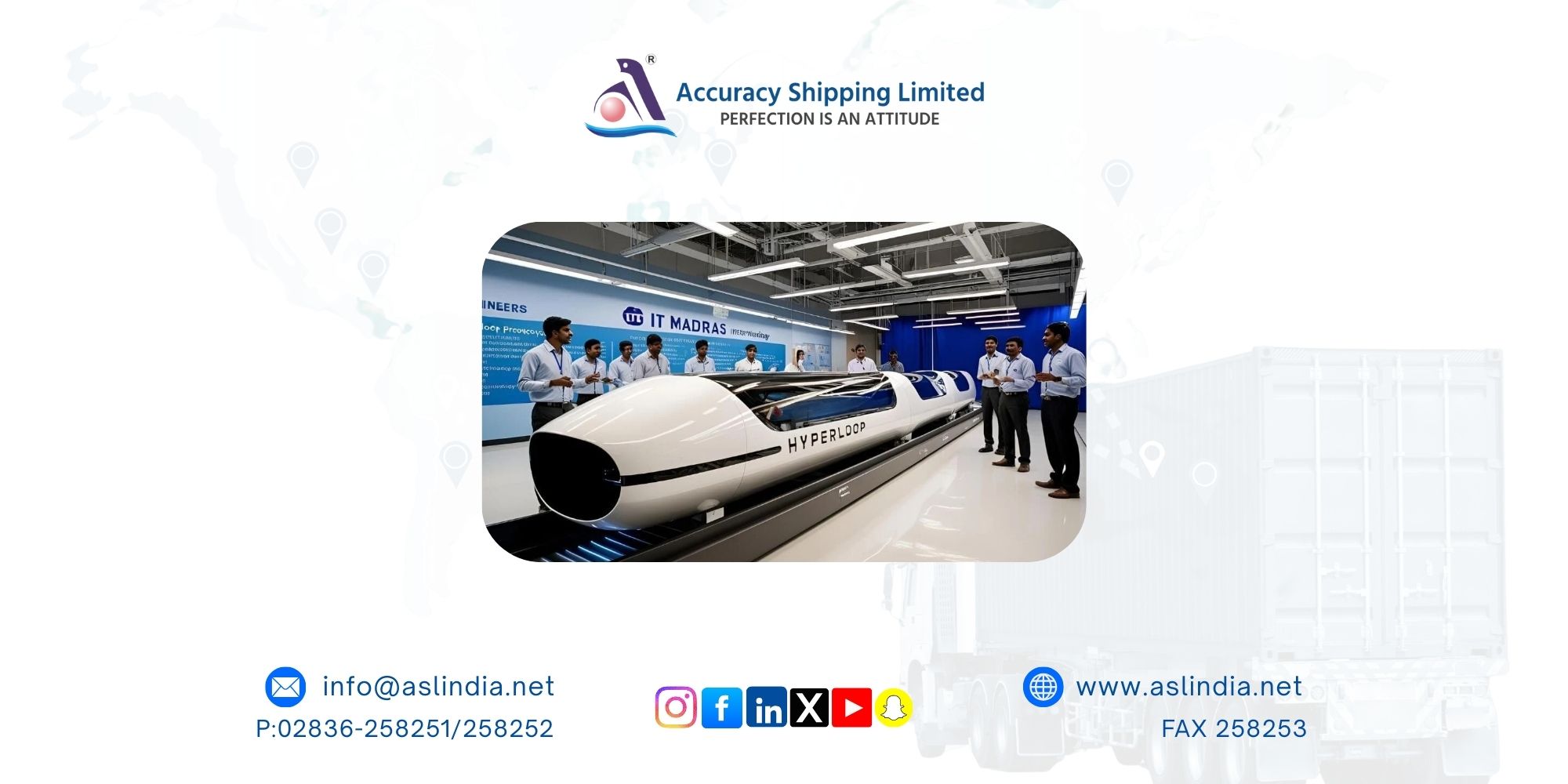
India has marked a global milestone in logistics innovation as Deendayal Port Authority at Kandla becomes the first port in the world to award a live commercial hyperloop-based freight contract. Moving beyond pilots and prototypes, the port has placed a ₹8.7 crore order with TuTr Hyperloop, a startup incubated at IIT Madras, signalling India’s decisive step into next-generation cargo logistics.
Solving a Long-Standing Port Bottleneck
Internal cargo evacuation has historically been a challenge at Kandla. Containers and bulk cargo often need to travel between three and eight kilometres from the berth to road and rail interfaces, leading to congestion, delays, and slower vessel turnaround times. The new hyperloop-inspired system aims to eliminate this bottleneck by creating a dedicated, ultra-fast internal freight corridor within the port, bypassing crowded truck lanes and saturated rail sidings.
How the Hyperloop Freight System Will Work
Under the contract, TuTr Hyperloop will develop and operate an electromagnetic cargo transport solution capable of moving 40-tonne containers directly from vessels to internal storage and loading areas at speeds of up to 200 kmph.
In the initial phase, the system will use linear induction motor (LIM) technology, where cargo pods are electromagnetically propelled along a guideway without conventional traction. Though not yet levitating, the design is robust enough to handle harsh port conditions such as dust, salt exposure, and continuous vibration. Each pod will carry between 40 and 100 tonnes, making it suitable not only for containers but also for difficult break-bulk cargo like timber.
Path to Full Magnetic Levitation and Sustainability
After successful commercial operations with LIM propulsion, TuTr Hyperloop plans to demonstrate full magnetic levitation at Kandla. The guideway and pod architecture are being designed to transition seamlessly from wheeled LIM operation to contactless levitation, reducing mechanical wear and long-term maintenance costs.
The cargo pods will be battery-powered, with charging supported by solar installations inside the port. This aligns closely with DPA’s sustainability objectives by lowering emissions and reducing dependence on fossil fuels.
A Blueprint for India’s Ports
Buoyed by the Kandla contract, TuTr Hyperloop is already in advanced discussions with Jawaharlal Nehru Port Authority and Kolkata Port Authority for similar deployments. Successful implementation across ports with very different operating environments would strongly support nationwide adoption of electromagnetic cargo transport systems.
For Deendayal Port Authority, this project positions Kandla as a global first mover implementing an indigenously developed, commercially validated hyperloop freight system backed by 3D scale model testing. While much of the world’s hyperloop work remains confined to experimental tracks and laboratories, India has taken a clear lead by bringing the technology into real-world port operations, setting a powerful precedent for the future of maritime logistics.
Our Tag:
Share:

.png)
.png)
.png)
Newsletters

 05 Jan, 2026
Cervical Cancer Awareness Month: Facts, Inequalities, Solutions – European Cancer Organisation
 03 Dec, 2025
India’s Russian oil purchases drop 33% as US sanctions bite
 05 Sep, 2025
iPhone 17 Pro launch in 4 days: Big RAM upgrade coming…
 20 May, 2025
Microsoft goes full agentic at Build 2025 with new AI tools, from Copilot coding agent to Discovery
 13 Sep, 2025

